Building a Trivia Titan: Victoria Groce's Flashcard Method
Based on insights from Victoria Groce's interview on Freakonomics Radio's "What It Takes to Know Everything" (2023)
With an arsenal of over 160,000 flashcards and a World Quizzing Championship title to her name, Victoria Groce stands as a reigning monarch in competitive trivia. Her dominance on the game show "The Chase" and consistent success in high-stakes competitions stem from a methodical approach to learning that anyone can adopt. At its core lies a sophisticated system of spaced-repetition flashcards, backed by cognitive science and refined through years of dedicated practice.
The Science Behind the Success
Understanding Groce's method begins with the fundamental processes of memory formation. Our brains create and maintain memories through three distinct stages:
- Encoding (converting new information into storable form)
- Retaining (maintaining information through neural connections)
- Recalling (accessing stored information when needed).
This biological framework underlies the effectiveness of Groce's approach.
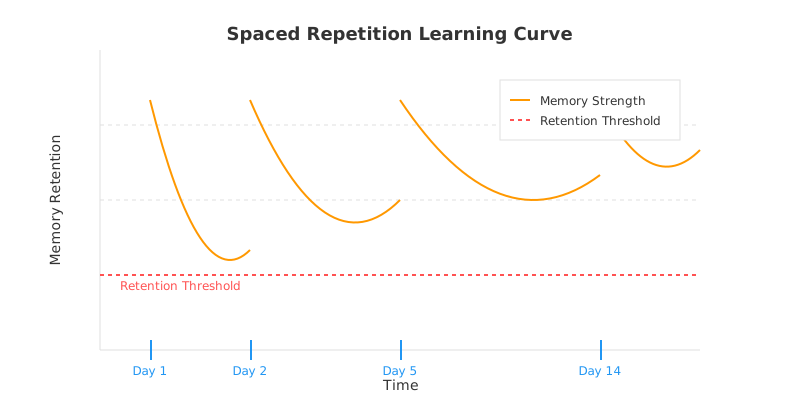
Spaced repetition, the cornerstone of her method, works by strategically timing when information is reviewed. Rather than cramming facts in a single session, information is revisited at gradually increasing intervals. This technique aligns with how our brains naturally process and strengthen memories. For instance, learning that Kigali is Rwanda's capital might involve reviewing it several times on day one, again the next day, then two days later, five days later, and so on. Each successful recall strengthens the neural pathways, making the information increasingly accessible.
The Method in Practice
Groce's massive collection of over 160,000 flashcards isn't just impressive in size—it's strategically crafted. Each card is designed around what she calls "hooks" and "pins." A hook is the attention-grabbing element of a potential trivia question, while a pin is the unique detail that leads to the correct answer. For example, in a question about the world's first nuclear-powered submarine, the hook might be "nuclear-powered," while the pin would be "USS Nautilus."
Her flashcard creation follows specific criteria:
- Clear, unambiguous information
- Focus on unique, distinguishing features
- Connections to related knowledge
- Multiple potential approaches to the same fact
Beyond the Basics
While flashcards form the foundation, Groce's success stems from a broader approach to knowledge acquisition. She actively engages with new information through various channels, allowing real-world experiences to reinforce her flashcard learning. For example, her encounter with tribology (the study of friction, wear, and lubrication) through professional work added depth to her technical knowledge base. This cross-pollination between daily life and structured learning creates a richer understanding of topics.
Curiosity drives her continuous expansion of knowledge. Rather than viewing trivia as isolated facts, she approaches each new piece of information as a potential connection to existing knowledge. This mindset transforms rote memorization into an engaging exploration of interconnected ideas.
The Training Regimen
Groce's daily routine demonstrates the level of commitment required for mastery:
- Adding approximately 250 new cards daily
- Spending 2-4 hours on review sessions
- Systematically tracking progress
- Regular participation in competitive events
Her review process is methodical, focusing on both accuracy and speed of recall. New cards are reviewed more frequently until they become firmly established in memory, following the principles of spaced repetition.
Implementing the Method
While building a collection of 160,000 flashcards isn't necessary for most learners, Groce's core principles can be adapted for personal use:
-
Start with Spaced Repetition
- Begin with digital flashcard apps that automatically implement spaced repetition
- Start small with 5-10 new cards per day
- Maintain consistent review schedules
-
Practice Active Recall
- Test yourself regularly
- Participate in casual trivia events
- Explain concepts to others
- Write your own questions
-
Curate Strategic Content
- Focus on identifying hooks and pins in new information
- Create clear, specific flashcards
- Build connections between related topics
- Review and refine cards regularly
-
Develop Consistent Habits
- Set aside dedicated study time
- Track progress to maintain motivation
- Join or form study groups
- Engage with subject matter beyond flashcards
-
Embrace Curiosity
- Follow interesting tangents
- Look for connections between topics
- Read widely across subjects
- Engage with diverse learning materials
Common Challenges and Solutions:
- Time management: Start with short, focused sessions
- Information overload: Begin with specific subject areas
- Motivation: Track progress and celebrate milestones
- Retention: Focus on understanding, not just memorization
By adopting these principles and adapting them to individual goals, anyone can begin building their own foundation for knowledge mastery. While reaching Groce's level requires exceptional dedication, her method offers a proven framework for systematic knowledge acquisition that can benefit any learner.
Citations
Additional Notes
Information in this article is primarily sourced from Victoria Groce's interview with Stephen J. Dubner on Freakonomics Radio. The specific methodology details, including the number of flashcards (160,000+) and daily practice routines (250 new cards per day), are directly quoted from this interview. The theoretical framework regarding memory formation and spaced repetition is based on established cognitive science principles, while the practical implementation details come from Groce's personal experience as described in the podcast.